St. Scholastica: Twin Sister of St. Benedict,
Abbess, and Model of Holy Friendship and Prayer
St. Scholastica: Twin Sister of St. Benedict,
Abbess, and Model of Holy Friendship and Prayer
St. Scholastica, the twin sister of St. Benedict of Nursia, stands as a luminous figure in the history of Western monasticism. Born around 480 AD in Nursia, central Italy, during a time of political chaos following the fall of the Western Roman Empire, she and her brother were raised in a devout Christian family of means. From her earliest youth, Scholastica consecrated her life entirely to God, showing little interest in worldly affairs despite her privileged upbringing. She embodied a profound detachment and single-hearted devotion that would shape the future of religious life for women in the West.
When St. Benedict left home to pursue the eremitical life and eventually founded his renowned monastery at Monte Cassino, Scholastica followed a parallel path of radical dedication. She established a monastery of nuns at Plombariola, approximately five miles from her brother’s community. Under Benedict’s guidance and the emerging Rule he developed, she served as abbess to the first community of Benedictine nuns. Their monasteries operated in close proximity yet maintained the strict separation proper to their vocations, reflecting the ordered, self-sustaining monastic model that would profoundly influence European civilization.
The siblings met only once a year, in keeping with the discipline of their respective communities. These encounters took place at a house some distance from the monasteries, where they spent the day in prayer and holy conversation about the spiritual life. One such meeting, their last on earth, has become iconic in Christian hagiography, as recorded by Pope St. Gregory the Great in his Dialogues (Book II, Chapter 33):
“The holy nun said to her brother: ‘Please do not leave me tonight; let us go on until morning talking about the delights of the spiritual life.’ ‘Sister,’ he replied, ‘what are you saying? I simply cannot stay outside my cell.’ When she heard her brother refuse her request, the holy woman joined her hands on the table, laid her head on them and began to pray. As she raised her head from the table, there were such brilliant flashes of lightning, such great peals of thunder and such a heavy downpour of rain that neither Benedict nor his brethren could stir across the threshold of the place where they had been seated. … ‘I asked you and you would not listen; so I asked my God and he did listen.’”
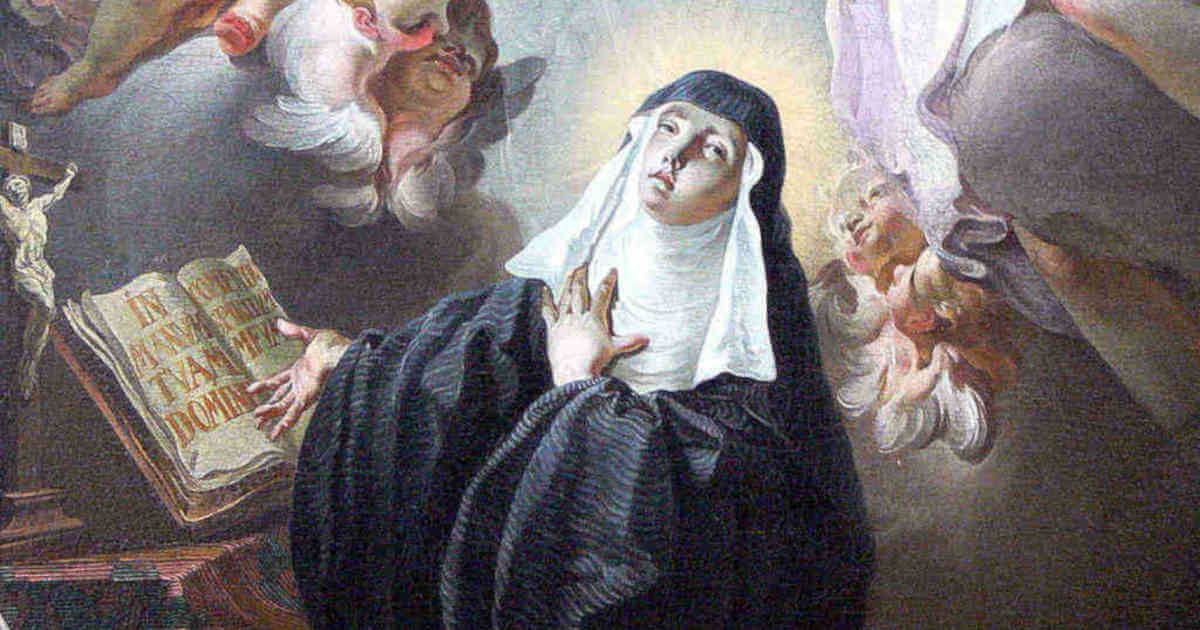
A violent thunderstorm, sent in answer to Scholastica’s prayer, prevented St. Benedict and his monks from returning to Monte Cassino. The siblings thus spent the night in spiritual conference, their shared love for God taking precedence. Pope St. Gregory the Great, reflecting on this event, observed that Scholastica’s prayer prevailed because of the greatness of her love: “She could do more, because she loved more.” (Sometimes rendered as “She did more which loved more.”)
Three days after their parting, Scholastica died around the year 543. In a vision, St. Benedict beheld her soul ascending to heaven in the form of a dove. He had her body brought to Monte Cassino and buried in the tomb he had prepared for himself. When he died a few years later, he was laid to rest beside her, so that in death, as in their shared vocation, the twins remained united. Their feast is celebrated on February 10.
The lives of St. Scholastica and St. Benedict exemplify the beauty and fruitfulness of the consecrated life. As the Catechism of the Catholic Church teaches:
“The life consecrated to God is characterized by the public profession of the evangelical counsels of poverty, chastity, and obedience, in a stable state of life recognized by the Church.” (CCC 944)
Through Baptism, the consecrated person “surrenders himself to the God he loves above all else [and] thereby consecrates himself more intimately to God’s service and to the good of the whole Church” (CCC 945). The state of consecrated life “belongs undeniably to [the Church’s] life and holiness” (CCC 914). Scholastica and her brother lived this reality fully, establishing communities ordered by prayer (ora) and work (labora), stability, and obedience, which preserved faith, learning, and culture through turbulent centuries.
Their annual meetings and final night of conversation also illustrate the profound value of holy friendship and shared contemplation. Pope Francis, in his apostolic exhortation Gaudete et Exsultate, highlights such bonds as sources of authentic mystical experience:
“Sharing the word and celebrating the Eucharist together fosters fraternity and makes us a holy and missionary community. It also gives rise to authentic and shared mystical experiences. Such was the case with Saints Benedict and Scholastica.”
In an age that often undervalues deep spiritual friendships, the twins remind us that we are made for communion with God and with one another. Their relationship—marked by mutual encouragement, reverence for each other’s vocation, and a love that ultimately yielded to divine will—offers a powerful witness to charity that builds up the Church.
St. Scholastica’s legacy endures as the spiritual mother of countless Benedictine nuns and as a patroness of those who seek God through contemplative prayer and holy friendships. May her intercession help us to love more deeply, pray more fervently, and surrender more completely to the God who hears the cries of His beloved children.
Sources
- St. Gregory the Great, Dialogues, Book II (primary source for the life and miracle of St. Scholastica).
- Catechism of the Catholic Church, paragraphs 914, 944, and 945.
- Pope Francis, Apostolic Exhortation Gaudete et Exsultate (19 March 2018), no. 142.
- Traditional Benedictine hagiography and liturgical commemorations (drawing on the above sources).