Saint Raymond
of Penafort
Saint Raymond
of Penafort
In the turbulent era of the 13th century, amid crusades and religious tensions, Saint Raymond of Peñafort emerged as a beacon of intellectual rigor, humble service, and unwavering kindness. Born around 1175 into a noble family in Villafranca de Benadis near Barcelona, Spain, Raymond was a relative of the King of Aragon and benefited from an elite education that set the stage for his remarkable contributions to the Catholic Church. From his early days as a philosopher and legal scholar to his later roles as a Dominican friar, papal advisor, and evangelist, Raymond's century-long life exemplified a profound commitment to God's law and the salvation of souls.
Raymond's intellectual journey began early. By age 20, he was teaching philosophy in Barcelona. In his thirties, he pursued advanced studies in Bologna, Italy, earning doctorates in both canon and civil law. He quickly gained renown as a professor, but his path shifted dramatically in 1222 when, at 47, he joined the Dominican Order after being inspired by the preaching of Blessed Reginald. As a friar, Raymond embraced humility and penance, channeling his talents into service. One of his first major works was the *Summa de Casibus Poenitentiae*, a manual for confessors that went beyond mere lists of sins to integrate Church doctrines and laws, aiding priests in guiding penitents with compassion.
His reputation for wisdom soon reached the highest echelons of the Church. In 1230, Pope Gregory IX summoned Raymond to Rome, appointing him as his chaplain, confessor, and grand penitentiary. The Pope entrusted him with a monumental task: compiling and organizing the scattered decrees of popes and councils issued since Gratian's collection 80 years prior. Raymond produced the *Decretals of Gregory IX*, a five-volume codification that streamlined canon law, eliminating redundancies and contradictions. In a papal bull addressed to the universities of Paris and Bologna in 1231, Pope Gregory IX praised the work, declaring that "the work of St. Raymond alone should be considered authoritative, and should alone be used in the schools." The bull further highlighted the flaws in earlier collections, noting that "many of the decrees in the collections were but repetitions of ones issued before, many contradicted what had been determined in previous decrees, and many on account of their great length led to endless confusion, while others had never been embodied in any collection and were of uncertain authority." This endorsement solidified the *Decretals* as the foundation of Church law until the 1917 Code of Canon Law.
Despite such honors, Raymond shunned worldly prestige. At 60, he was appointed Archbishop of Tarragona but resigned after falling ill, viewing the position as incompatible with his Dominican vows of humility. Three years later, in 1238, his fellow Dominicans elected him as the third Master General of the Order, succeeding Saint Dominic. During his brief two-year tenure, he visited communities on foot, revised the Order's constitutions to allow resignation of the Master General, and promoted missionary work. Upon stepping down at 65, Raymond dedicated his remaining decades to evangelism, particularly among Jews and Muslims in Spain. He founded schools for studying Hebrew and Arabic to facilitate dialogue and conversion, and he encouraged Saint Thomas Aquinas to author the *Summa Contra Gentiles* as a theological tool for these efforts. Official Church accounts, such as those from Vatican News, note that through his preaching, Raymond reportedly converted 10,000 Muslims.
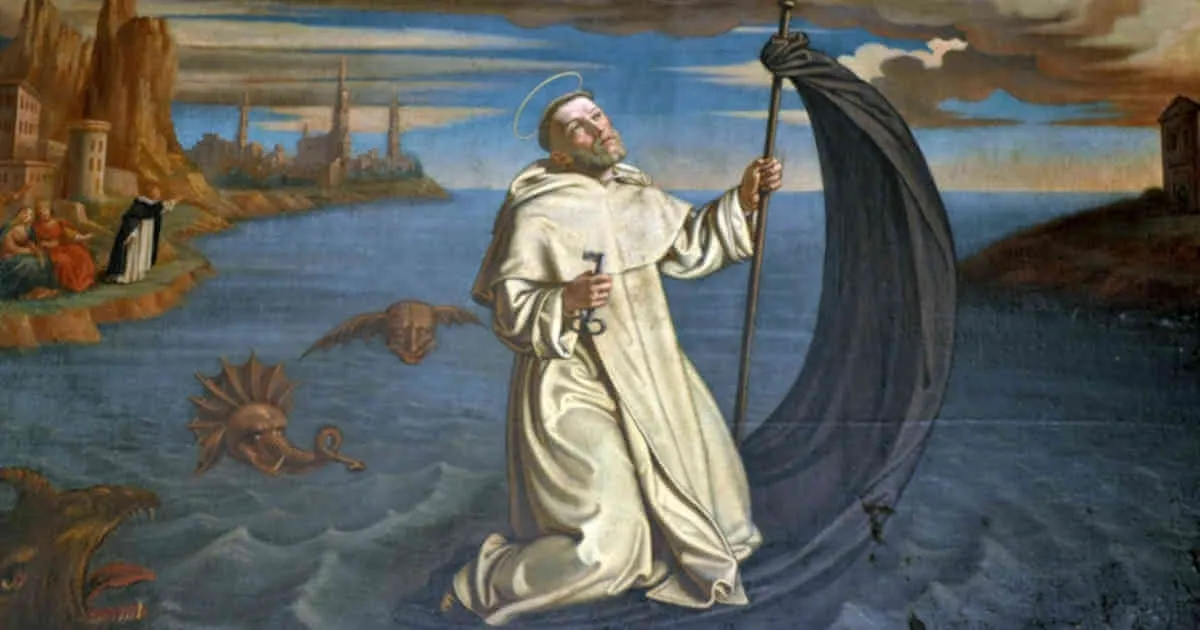
Raymond's life was also marked by legendary acts of faith and moral courage. A famous story recounts his time accompanying King James I of Aragon to Majorca, where the king persisted in sinful liaisons despite Raymond's counsel. When the king refused to let him leave, Raymond miraculously spread his cloak on the sea, using it as a sail to cross back to Barcelona—a tale symbolizing divine intervention and Raymond's unyielding devotion. Additionally, with King James and Saint Peter Nolasco, he co-founded the Order of Our Lady of Ransom (Mercedarians), dedicated to redeeming Christian captives from Moorish hands, reflecting his deep Marian devotion from childhood.
Throughout his ministry, Raymond emphasized kindness as a path to peace in a hostile world. As the Catholic Encyclopedia recounts, he urged confessors to approach sinners with understanding, turning "enemies into friends, conflicts into peace, and ignorance into understanding." In a letter attributed to him, Raymond wrote: "Look then on Jesus, the author and preserver of faith: in complete sinlessness he suffered, and at the hands of those who were his own, and was numbered among the wicked. As you drink the cup of the Lord Jesus (how glorious it is!) give thanks to the Lord, the giver of all blessings." Another reflection from his writings, preserved in official Catholic sources like Anastpaul, states: "Your purity of life, your devotion, deserve and call for a reward because you are acceptable and pleasing to God."
Raymond lived to 100, passing away on January 6, 1275, in Barcelona. Miracles were attributed to him even on his deathbed, where he was visited by royalty. The Church formally recognized his sanctity when Pope Clement VIII canonized him on April 29, 1601. In the bull of canonization, as referenced by EWTN, the Pope highlighted Raymond's virtues of mercy and compassion. Today, the Church honors him on January 7 as the patron saint of canon lawyers, Barcelona, and medical record librarians, with symbols like his sea-crossing cloak representing faith's triumph over adversity.
Saint Raymond's legacy endures as a model for integrating intellect, law, and charity in service to the Church. In an age of division, his choice of understanding over confrontation reminds us, as Franciscan Media reflects, that "kindness is rarely thought of as a virtue in our aggressive and hostile culture, but its power is unfathomable." Through his works and witness, Raymond invites us to seek compassion in our interactions, fostering peace and conversion.
List of Sources
- Catholic Encyclopedia (New Advent): "St. Raymond of Penafort" (https://www.newadvent.org/cathen/12671c.htm)
- Vatican News: "St. Raymond of Penyafort" (https://www.vaticannews.va/en/saints/01/07/st--raymond-of--penyafort--dominican--co-founder-of-the-mercedar.html)
- Franciscan Media: "Saint Raymond of Peñafort" (https://www.franciscanmedia.org/saint-of-the-day/saint-raymond-of-penafort/)
- EWTN: "St. Raymond of Penafort" (https://www.ewtn.com/catholicism/saints/raymond-of-penyafort-746)
- Anastpaul: "Quote/s of the Day – 23 January – St Raymond of Peñafort" (https://anastpaul.com/2024/01/23/quote-s-of-the-day-23-january-st-raymond-of-penafort-1175-1275/)
- My Catholic Life!: "Saint Raymond of Peñyafort" (https://mycatholic.life/saints/saints-of-the-liturgical-year/january-7-saint-raymond-of-penyafort/)
- Britannica: "St. Raymond of Penafort" (https://www.britannica.com/biography/Saint-Raymond-of-Penafort)